

Currently Empty: ₦0.00


Will AI Replace Your Job? How to Future-Proof Your Career in Nigeria (2026)
If you have been asking yourself whether AI will replace your job, the honest answer is more useful than most panic headlines suggest. AI is not wiping out jobs across Nigeria in one sweep. What it is doing is splitting the workforce into two groups: people who have learned to work alongside AI tools, and people who have not yet started. This guide walks through what is actually happening in the Nigerian job market right now, which roles face the most pressure, which roles are gaining ground, and a realistic plan for future proofing your career in 2026 without quitting your job to go back to school.
So, Is Your Job Actually at Risk From AI?
The data tells a more measured story than most people expect. Nigeria’s National AI Strategy sets a short term target, covering 2024 to 2026, to upskill 100,000 professionals in AI. This sits inside a much larger push that includes the 3 Million Technical Talent programme, which aims to build three million AI ready workers across the country. Governments do not commit that level of funding and planning to a workforce they expect to disappear. They invest heavily in workforces they expect to need different skills, delivered quickly, at national scale. Read against that backdrop, the real divide in the Nigerian job market has very little to do with which job title you hold. It has everything to do with whether you have started adapting or you are still waiting to see what happens.
Which Roles Are Losing Ground, and Which Are Gaining It
Roles built almost entirely around repetitive, predictable tasks face the most pressure from AI automation, because those are exactly the tasks AI handles well today. Basic data entry, simple scripted customer support, and routine scheduling all fall into this category, and companies are already automating pieces of them. On the other side of that same shift, demand is rising quickly for people who can direct AI tools rather than compete with them. Data analysts who can interpret what these tools produce, AI product managers who decide what gets built with these new capabilities, and automation specialists who wire AI into real business workflows are all becoming harder to hire for, not easier. The safest place to stand in this shift is close to AI, using it well, rather than far away from it.
Three AI Skills Worth Building No Matter What You Do
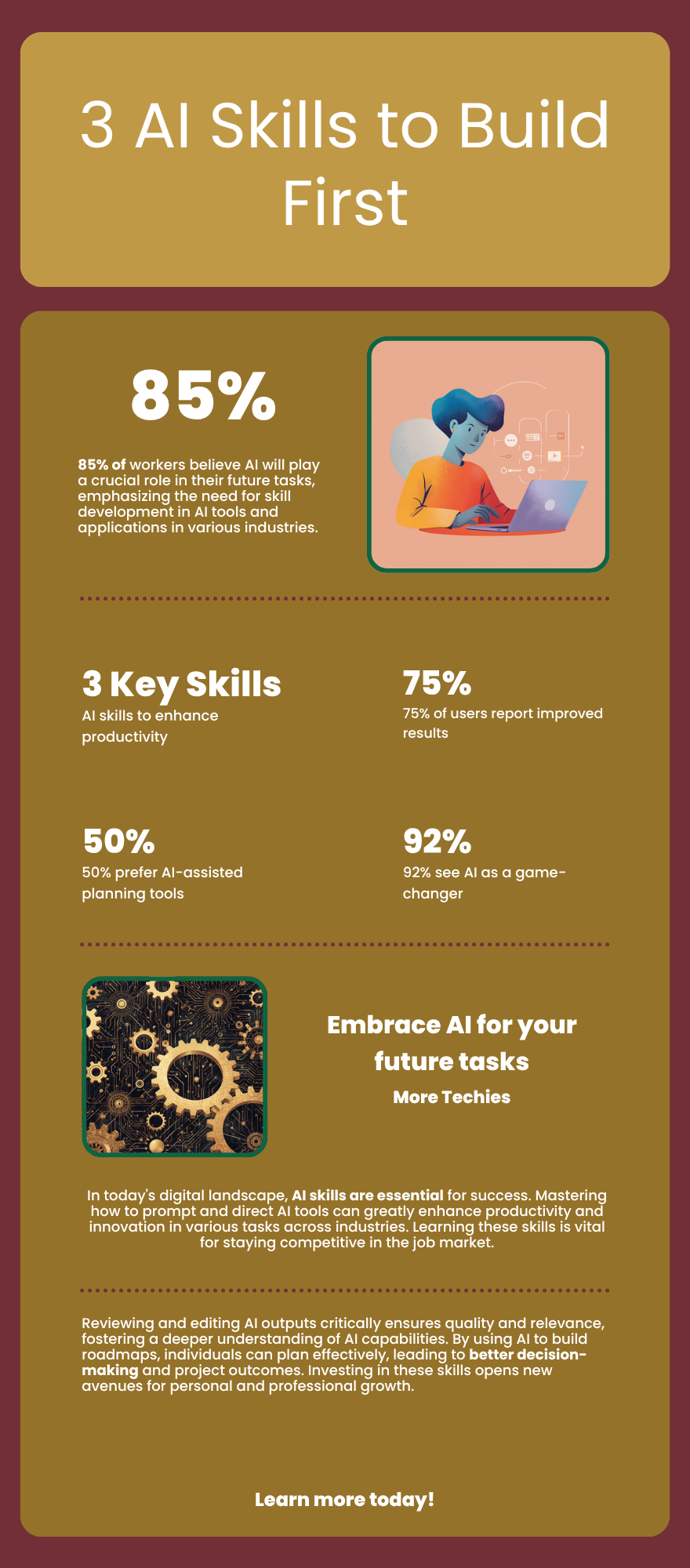
Regardless of your industry, three capabilities matter more than any specific tool right now. The first is genuine AI literacy, meaning knowing how to give an AI tool enough context and clear direction to produce something actually useful, instead of typing a single vague question and giving up when the answer disappoints. The second is workflow automation, meaning understanding how to connect AI into the repetitive parts of your actual job on an ongoing basis, rather than using it for the occasional one off task and forgetting about it afterward. The third is data literacy, meaning being able to read, question, and sanity check what an AI tool produces, because these tools can sound confident while being wrong, and knowing when to trust the output is now a real professional skill in its own right.
Why a Long Course Is the Wrong Tool for This Problem
If you are already working full time, a long theoretical course rarely solves this problem well. Most working professionals do not have six months to sit through lectures before applying anything, and a lot of people who finish a general AI course still cannot point to one specific thing they now do differently at work. What actually closes the gap is a tighter loop: learn a capability, apply it to a real problem at your job within the same week, get honest feedback on how it went, and refine it before moving on. That loop, repeated consistently, is what turns a vague awareness of AI into a professional habit of using it well every week.
How TAP Turns This Into a 12 Week Plan
This loop is the entire model behind our Talent Accelerator Programme, known as TAP. Over 12 weeks, delivered live online, professionals apply one high impact digital capability such as AI or automation to a real challenge inside their own workplace or business, with structured feedback built into every stage. You do not leave with a certificate that simply confirms you attended sessions. You leave with a completed implementation project you can describe in an interview, defend in front of your manager, or use to justify a promotion. If you want a closer look at what applying AI at work actually looks like day to day before committing to a programme, we have also written a detailed breakdown of how to actually use AI at work. If your background sits in banking, finance, or operations specifically, our guide to becoming a fintech product designer in Nigeria shows how the same implementation first model applies to a full career pivot, not only a skills refresh. For a role-by-role breakdown of exactly which tech jobs carry the least risk, see which Nigerian tech jobs are safest from AI in 2026.
Frequently Asked Questions
Is my job at risk from AI?
Your risk depends far more on whether your role is built around repetitive, predictable tasks than on your job title alone. Even in lower risk roles, the more immediate concern for most professionals is falling behind colleagues who have already started using AI well, rather than being replaced by AI outright.
Do I need to learn to code to future proof my career?
No. The AI adjacent skills currently in highest demand, including prompting, workflow automation, and data literacy, are all learnable without any coding background, using conversational AI tools and no code platforms.
How long does it take to become confident using AI at work?
Most professionals notice a real, measurable difference within a few weeks of consistent, applied practice on real tasks. Reading about AI for months without applying it produces far slower progress than a few focused weeks of hands on use.
What is the fastest way to start?
Pick one AI adjacent skill, apply it to a real recurring task at your job this week, and build from there on your own. If you want structured feedback and accountability along the way, a programme like TAP is built specifically for that.